Fann Mountains from Uzbekistan: how to get there, routes, season and documents
The most beautiful mountains of the Pamir-Alai begin an hour’s drive from Samarkand. Where they are, how to cross the border, how many days to allow, when to go and what documents you need — a guide from the people who lead groups there.
In this article
The Fann Mountains are two dozen five-thousand-metre peaks and thirty lakes in every shade from milky turquoise to ink blue, an hour and a half from Samarkand. Russian trekking clubs bring groups here via Samarkand and write “fly in, we’ll meet you”. We live on the other side of the border and have led groups to the Fanns since 2018, so here is the view from Tashkent and Samarkand: where and how to cross the border, which documents you need, when to go, how many days to allow and how a three-day trip differs from a nine-day trek.
Where the Fann Mountains are
The Fanns lie in the south-west of the Pamir-Alai, between the Zeravshan Range to the north and the Gissar Range to the south, in Tajikistan’s Sughd region. From Samarkand it is 40 km to the border and another 90 or so to the Artuch alpine camp; from Dushanbe, 220 km over the Anzob pass. The name is usually traced to the Fandarya river, which bounds the area to the east; the neighbouring ranges translate as “fortress” (Gissar) and “gold-giving” (Zeravshan) — gold is still mined here.
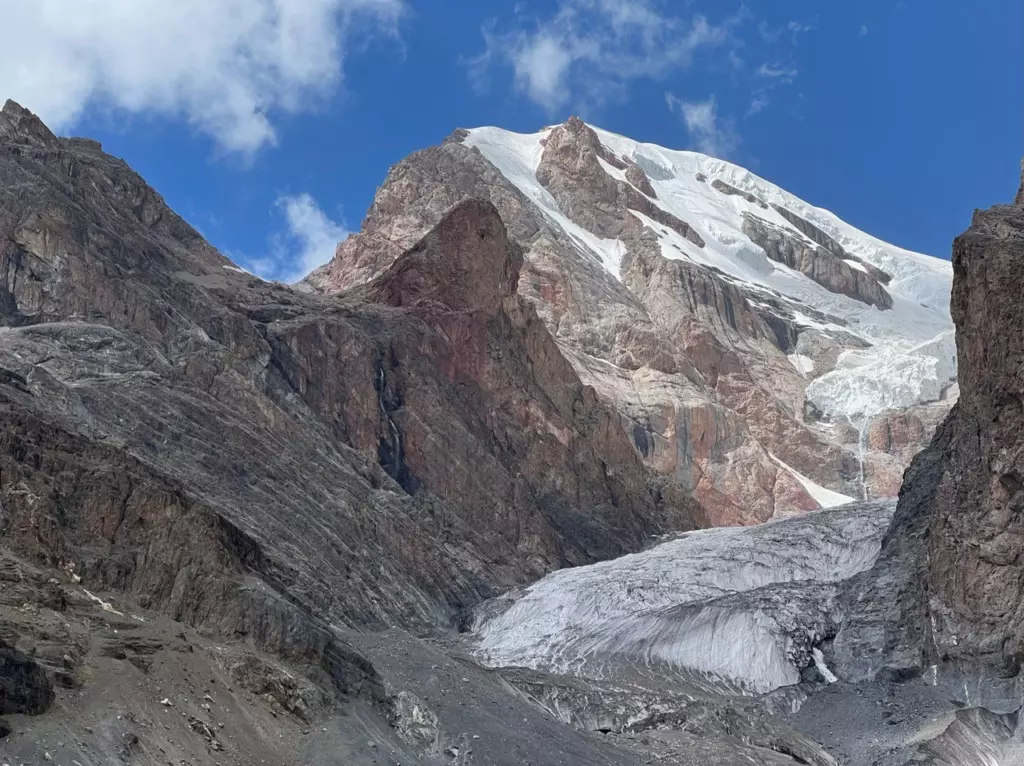
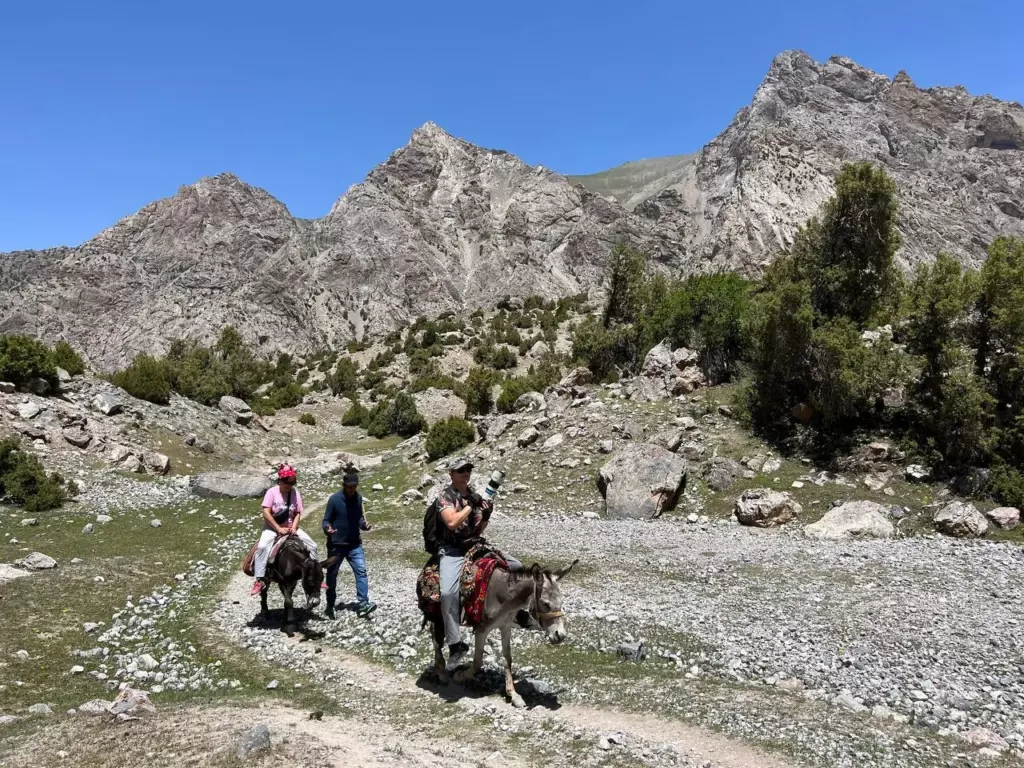
What people come for is the combination of altitude and accessibility. The highest point, Chimtarga, is 5,489 m; next to it stand Bolshaya Ganza (5,306), Bodkhona (5,138), Mirali (5,132), Energia (5,120), Zamok (5,070) and Chapdara (5,050). Yet the trails between the lakes run at 2,200–3,500 m, the grade 1A–1B passes are crossed without ropes, and donkeys carry the packs. That is why the Fanns are the classic “first serious trek” for anyone who has already hiked Chimgan and wants more.
Lakes and passes: what you will see
| Place | Altitude | What it is |
|---|---|---|
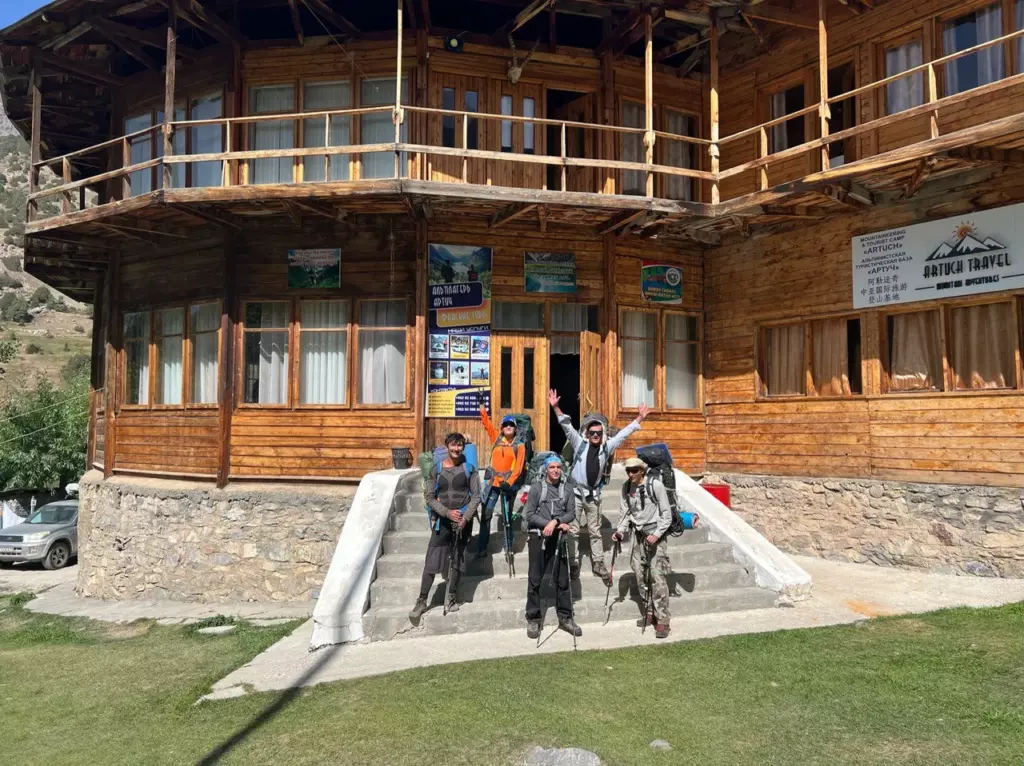
| Artuch mountaineering camp | 2,200 m | base camp on the northern side with cabins and a café, open from 1 May to 1 October; every route from Uzbekistan starts here |
| Lake Chukurak | 2,440 m | acclimatisation walk on the first day, 4 km there and back |
| Kulikalon Lakes | approx. 2,800 m | a basin of seven lakes beneath the Kulikalon Wall, juniper forest, fish; Lake Bibijanat is the first night’s camp |
| Alaudin pass | approx. 3,730–3,800 m, grade 1A | the key pass between Kulikalon and Alaudin; from the saddle you see Chapdara and the Dushakha lakes |
| Alaudin Lakes | approx. 2,800 m | the most photographed lakes of the Fanns, from pale blue to ultramarine; the Vertical-Alaudin camp (2,626 m) and a teahouse are nearby |
| Mutnye Lakes | approx. 3,500 m | glacial lakes at the foot of Chimtarga and Energia; beyond them the high mountains begin |
| Chimtarga pass | 4,750 m, grade 1B | the highest point of the classic loop; the night before is spent below the pass at 4,450 m |
| Bolshoye Allo | 3,140 m | a lake born in 1912, when an earthquake dammed the river; considered the most beautiful in the Fanns |
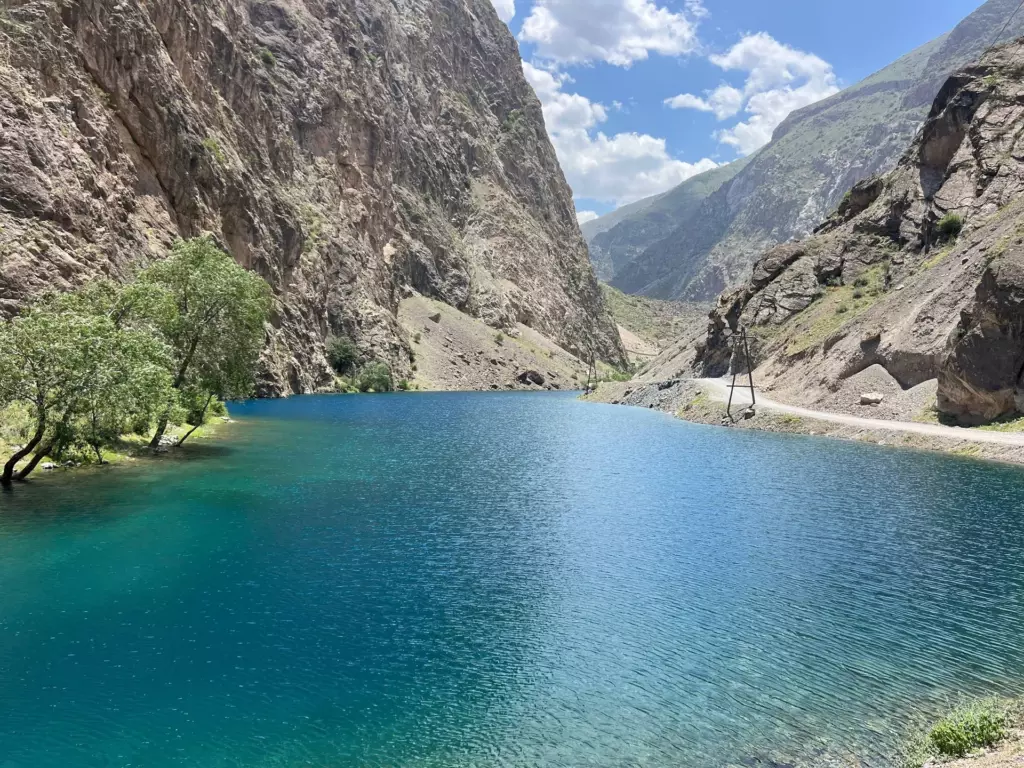
| Marguzor (Seven) Lakes | 1,640–2,400 m | a chain of seven lakes in the Shing gorge — Nezhigon, Soya, Gushor, Nofin, Khurdak, Marguzor, Hazorchashma; reachable by car |
| Iskanderkul | 2,195 m | the largest lake in the area, 3.4 km², up to 72 m deep; nearby are the 43-metre “Fann Niagara” waterfall and Snake Lake |
Pass heights differ by tens of metres from source to source — that is normal in the mountains; the table gives the figures from our programmes and reference guides.
How to get there from Uzbekistan
From Samarkand — the shortest way. The Jartepa (Uzbekistan) – Sarazm (Tajikistan) border crossing is open around the clock and lies 40 km from Samarkand, about an hour by car; you walk across, then it is 20 km to Penjikent. On an ordinary day the crossing takes 10–30 minutes; queues form at 7–8 in the morning and 19–20 in the evening. From Penjikent to Artuch is another two hours or so on a mountain road with no public transport — taxi or the camp’s own vehicle only. In total Samarkand – Artuch: 130 km and 3–4 hours including the border.
From Tashkent. Two options: take the Afrosiyob train to Samarkand in 2 hours 10 minutes and continue as above — or drive directly via Khujand: leave at 5 a.m., cross at Oybek – Fotehobod, breakfast on Khujand manti and drive to Artuch through the Shahristan tunnel. This way Tashkent – Artuch takes 3–4 hours including the border. Our 7- and 9-day tours are built this way: start in Tashkent, finish in Tashkent or Dushanbe.
From Dushanbe. 220 km and 4–5 hours through the Anzob tunnel and over the pass; this is the convenient way back if you finish at Iskanderkul and fly out of Dushanbe. There are direct flights to both Samarkand and Dushanbe from many countries.
Documents and the border
- Visa. Since 2022 citizens of all EU states, the United Kingdom, the USA, Canada, Japan and around fifty other countries enter Tajikistan visa-free for up to 30 days. Citizens of Russia, Kazakhstan, Kyrgyzstan, Belarus and Georgia need no visa and have no limit on their stay; Armenia, Azerbaijan and Ukraine — up to 90 days. Everyone else applies for an e-visa at evisa.tj: 30 US dollars, up to 60 days. The GBAO permit mentioned in trip reports is needed only for the Pamirs — not for the Fann Mountains.
- Passport. Valid for at least six months after you leave Tajikistan. This is stricter than Uzbekistan’s rule, so check the expiry date.
- Registration in Tajikistan. A foreigner must register if they stay longer than 10 working days (about 14 calendar days); on a short route it is not needed, on a long one the host company handles it. In October 2026 parliament approved extending the period to 15 working days — once the law takes effect it will be even simpler.
- Registration in Uzbekistan on your return is done automatically by your hotel, as usual.
- Migration fee. Foreigners entering Tajikistan pay a migration fee of about 20 US dollars; it is paid at the border and is not included in the price of our tours.
- Money. Tajikistan has its own currency, the somoni; on the trail you need it only for souvenirs and tea at the teahouse by the Alaudin lakes. Dollars can be exchanged in Penjikent or Khujand; cards do not work in the mountains. Our tours include meals, accommodation and eco-fees, so you can set off on the trek with almost no cash.
When to go
The season in the Fanns is shorter than in Chimgan: the Artuch camp is open from 1 May to 1 October, and the passes above 3,500 m are clear of snow only by July.
- June — green and quiet, but there is still snow on the Alaudin pass and even more on Chimtarga; fine for Kulikalon and the Seven Lakes, not for the loop.
- July – August — the main season: all passes open, almost no rain (about 250 mm falls here in a year, just a few days of it in summer), about +30 °C by day at 2,000 m and +10 °C at night; at 3,500 m nights are around zero even in August. Our 9-day group departures run in these months.
- September — golden autumn and fewer people, but colder and with shorter days; by the end of the month the first snow falls on the passes.
- May and October — low routes only: the Seven Lakes, Iskanderkul, Chukurak. The “Fann Mountains in May” people search for is not a trek but a car trip to the lakes.
Routes: 3, 7 or 9 days
Three days — the Kulikalon lakes. Leave Tashkent or Samarkand at 5 a.m.; after the border, lunch and the Artuch base, then an afternoon walk to lakes Chukurak and Beloye. Day two is a loop around all seven Kulikalon lakes with a picnic; day three is the drive back, arriving in Tashkent around 6 p.m. Nights in cabins, no tents needed, moderate elevation gain. It is the best way to find out whether the Fanns are really for you. Kulikalon lakes in 3 days — 260 US dollars, June to October.
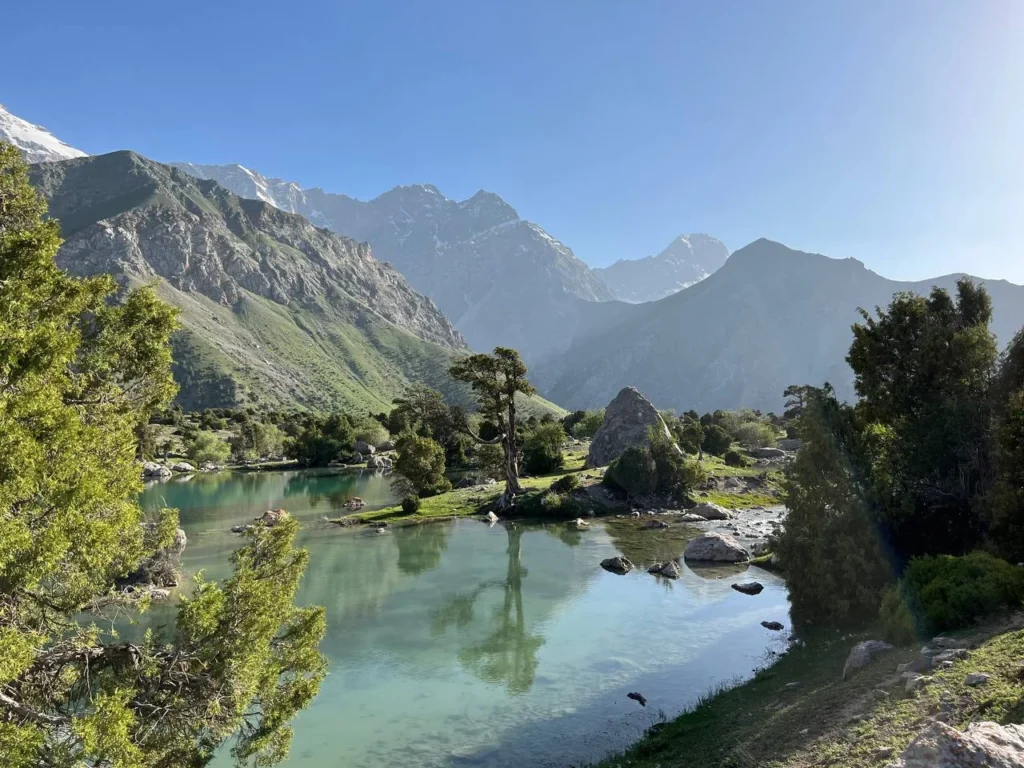
Seven days — the grand lakes tour, walking light. Artuch — Kulikalon — Alaudin pass — Alaudin and Mutnye lakes — Vertical camp — Marguzor lakes — Iskanderkul — Dushanbe. Donkeys carry the main luggage, and the nights alternate: cabins, two nights in tents, a guesthouse on the fourth Marguzor lake, a hotel in Dushanbe. One graded pass; the rest is walking between lakes and driving. Suits those who have done multi-day hikes of moderate difficulty. Magic of the Fann Lakes — 7 days, price on request.
Nine days — the classic loop over Chimtarga. Artuch → Kulikalon (2,800) → Alaudin pass → Alaudin lakes → rest day → Mutnye lakes (3,490) → camp below the pass (4,450) → Chimtarga pass (4,750) → Bolshoye Allo (3,140) → Maloye Allo → Gazza → Artuch. Donkeys carry the packs for the first days; above the Mutnye lakes it is porters or your own shoulders. Walking days are 6–19 km, the hardest being the descent from Chimtarga: 12 km and 1,600 m down over scree. This is a real mountain trek with tent nights at altitude, but without ropes or crampons. Trekking in the Fann Mountains — 9 days, 950 US dollars, group departures in July–August and private dates.
All three start in Tashkent, and the first two can also start in Samarkand — convenient to combine with a Samarkand city tour the day before.
Difficulty and preparation
No mountaineering experience is needed: this is trekking, and the 1A and 1B passes are crossed on trails and scree. What you need is stamina: walking 5–7 hours a day with an 8–12 kg pack (on routes with donkeys, just a daypack). A simple test from our practice: if you can walk 15 km with a ten-kilo pack and are ready to do it again the next day, the nine-day loop is within your reach. If not, start with three days.

Altitude is the second issue. Kulikalon and Alaudin at 2,800 m are easy to cope with; the Mutnye lakes at 3,500 and the night at 4,450 need acclimatisation, which is why the nine-day programme has a rest day and gains height in steps. How to prepare and what to do at the first signs of altitude sickness is in our article “Altitude sickness: how to prepare for high mountains”. For 2–3 months before the trek: running or cycling and weekend hikes with a pack — Small Chimgan and Tavaksay are perfect for that.
What to bring and what to know on the trail
- Gear. Trekking boots with ankle support, poles, a sleeping bag rated to −5 °C for the tent nights, a down jacket or warm fleece — at 4,450 m it freezes at night even in August. All personal and camp equipment — tents, sleeping bags, mats — can be rented from us. The full list is in the article “What to pack for a hike in the mountains of Uzbekistan”; for the Fanns add a warm layer and sun protection: the sun at altitude is harsher than in Chimgan.
- Phone signal. There is coverage at Artuch and by the Alaudin lakes, none higher up; the guide carries a satellite phone. Warn your family that you will be out of touch for 3–7 days.
- Water and food. The water in the lakes and streams is clean, but at the lake camps we boil it; meals on the trail are cooked by the team, and the Alaudin teahouse serves bread and tea.
- Insurance. For trekking above 3,000 m take a policy that covers active sports and evacuation: a rescue in the Fanns means a helicopter from Dushanbe.
- Rubbish. We carry everything out; the Fanns are still clean precisely because people come here in organised groups.

Frequently asked questions
7 answers to frequently asked questions
Where are the Fann Mountains?
In Tajikistan, in the Sughd region, between the Zeravshan and Gissar ranges of the Pamir-Alai. The nearest big city is Samarkand in Uzbekistan: 40 km to the border and about 130 km to the Artuch alpine camp. From Dushanbe it is 220 km over the Anzob pass.
When is the best time to visit the Fann Mountains?
July and August: all passes are open, there is no rain and the days are warm. June and September suit routes below 3,000 m — Kulikalon, the Seven Lakes, Iskanderkul. In May and October only car trips to the lower lakes are possible: the passes are under snow.
Do I need a visa for Tajikistan?
Citizens of the EU, the UK, the USA, Canada and Japan enter visa-free for up to 30 days; citizens of Russia, Kazakhstan, Kyrgyzstan and Belarus need no visa at all. Your passport must be valid for at least six months after departure. Registration is required only for stays longer than 10 working days. Everyone else applies for an e-visa at evisa.tj.
Can I go to the Fann Mountains without experience?
For three days to the Kulikalon lakes — yes, with normal fitness. For the loop over the Chimtarga pass (4,750 m) you should have multi-day hiking experience and be ready to walk 5–7 hours a day; no mountaineering skills are needed.
How many days do you need for the Fann Mountains?
Three days for the Kulikalon lakes from Tashkent or Samarkand; seven for the grand lakes tour with Iskanderkul and Dushanbe; nine for the classic loop over the Alaudin and Chimtarga passes.
Why are they called the Fann Mountains?
After the Fandarya river, which bounds the area to the east; in Tajik the mountains are called Kūhhoi Fon. The neighbouring ranges have telling names: Gissar means “fortress”, Zeravshan “gold-giving”.
How do I cross the border from Samarkand?
Through the Jartepa – Sarazm crossing 40 km from Samarkand: it is open around the clock, you walk across the neutral strip, and on an ordinary day it takes 10–30 minutes. On the Tajik side it is 20 km to Penjikent, then on into the mountains by the camp’s vehicle or taxi. On our tours we cross together with the guide, with transport waiting on both sides.
Didn’t find an answer?
Ask a questionWant to see the Fanns without the logistics, queues and acclimatisation maths? Choose a format — three days at the Kulikalon lakes, seven days around the lakes with donkeys or nine days over Chimtarga — and write to us: we will match dates, gear and programme to your fitness. And if you are drawn even higher, there is the Pamir Highway.