When and how to visit Uzbekistan: the complete first-trip guide for 2026–2027
When to go, what to pack, how to get there and how many days to allow. Everything you need to know before a first trip to Uzbekistan, in one article with tables of weather, trains and entry rules.
In this article
- When to go: the short answer
- Weather by month in four cities
- Season by season
- Holidays and dates that affect your trip
- Documents and entry
- How to get there
- Getting around the country
- Money, cards and mobile data
- What to see and how many days you need
- Food, etiquette and dress code
- Safety and health
- What to pack
- Frequently asked questions
Uzbekistan has a sharply continental climate and four very different seasons: apricot trees blossom in April, Bukhara bakes at +40 °C in July, bazaars overflow with melons in October, and Khiva stands in snow in January. That is why “when to go” is the first question of any trip, and the answer depends on what you want to see: the ancient cities, the mountains, the desert, or all of it at once. We have been running tours in Uzbekistan for more than nine years, and we have put everything people ask before a first visit into one article: seasons and monthly weather, documents and registration, money, trains, routes, clothing and safety. All figures are for 2026–2027.
When to go: the short answer
| What you want to see | Best time | Possible, with caveats |
|---|---|---|
| Samarkand, Bukhara, Khiva | April – May, September – October | March and November are cool but crowd-free; winter is empty and cheap |
| Mountains near Tashkent: one-day hikes | April – June, September – October | July – August only with an early start; winter is for skiing |
| Multi-day trekking, high mountains | June – September | May — the passes are still under snow |
| Kyzylkum Desert, the Aral Sea, Muynak | April – May, September – October | summer is +40 °C and above, winter brings wind and frost |
| Skiing: Amirsoy, Chimgan, Beldersay | December – March | |
| Low budget and few tourists | November – February | short days; frosty nights in Khiva and Bukhara |
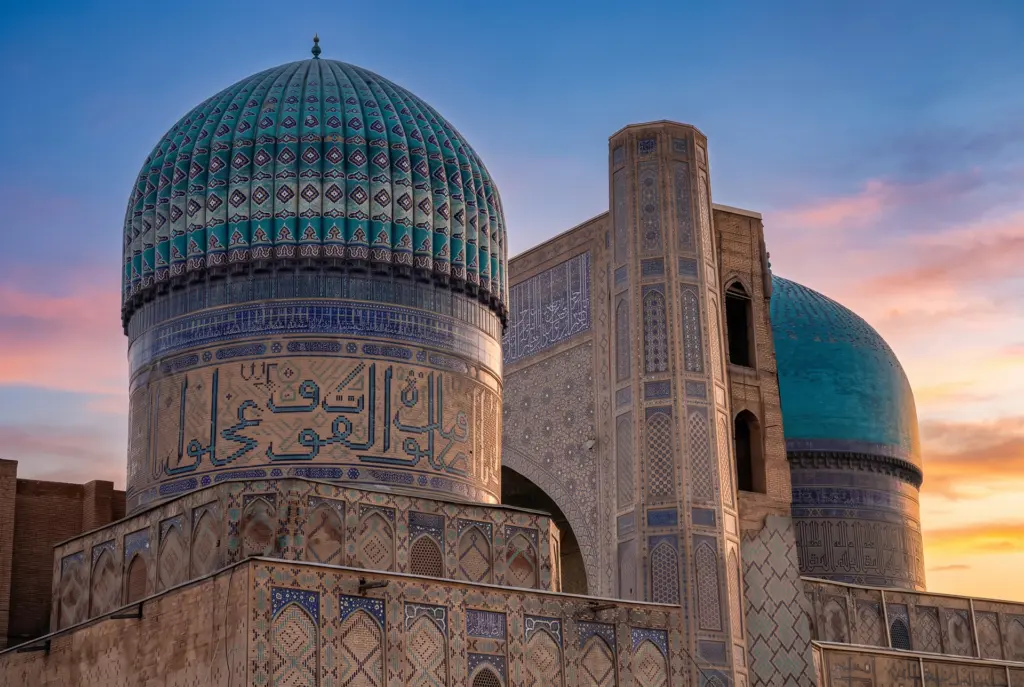
The two “golden” windows — April–May and September–October — are also peak season: in these months hotels in Samarkand and Bukhara and seats on the Afrosiyob train are booked several weeks ahead.
Weather by month in four cities
Average daytime high and night-time low, 1991–2020 climate normals. Khiva is represented by Urgench, the nearest weather station, 30 km away.
| Month | Tashkent | Samarkand | Bukhara | Khiva (Urgench) |
|---|---|---|---|---|
| January | +7 / −1 | +7 / −1 | +7 / −2 | +3 / −6 |
| February | +10 / 0 | +10 / 0 | +10 / 0 | +6 / −4 |
| March | +16 / +5 | +15 / +5 | +17 / +5 | +14 / +2 |
| April | +22 / +10 | +21 / +10 | +24 / +11 | +22 / +9 |
| May | +28 / +14 | +27 / +14 | +31 / +16 | +29 / +15 |
| June | +34 / +18 | +32 / +18 | +36 / +20 | +34 / +19 |
| July | +36 / +20 | +35 / +20 | +37 / +22 | +36 / +21 |
| August | +35 / +18 | +33 / +18 | +36 / +19 | +34 / +18 |
| September | +30 / +13 | +29 / +14 | +30 / +14 | +28 / +12 |
| October | +22 / +8 | +22 / +8 | +23 / +7 | +20 / +5 |
| November | +14 / +4 | +14 / +3 | +15 / +2 | +11 / 0 |
| December | +9 / 0 | +9 / 0 | +8 / −1 | +4 / −4 |
What the table shows:
- Rain falls only from November to May. Tashkent gets more rain in March–April than in the whole summer and autumn combined; from June to September there is almost none, so you can leave the umbrella at home.
- Bukhara and Khiva are drier and more extreme than Tashkent. In summer they are 1–2 degrees hotter; in winter Khiva drops to −6 °C at night, and the houses of Ichan-Kala are made of clay, so bring a warm jacket.
- Chilla. The forty hottest days, by the folk calendar from 25 June to early August: a steady +38…+42 °C by day, with Tashkent’s record at +44.6 °C. Sightseeing moves to 7–10 a.m. and after 6 p.m.; the middle of the day is for a pool, a thick-walled madrasah hotel or the mountains: at 1,600 m in Chimgan a July afternoon is around +26 °C.
- Spring arrives in a rush. March is still +15 °C, May is already +28 °C. The most beautiful time is the second half of April: orchards in bloom, green foothills, and not yet hot.
Season by season
Spring: March – May
The best time for a first visit. Daytime +20…+28 °C, apricot and almond trees in blossom, green foothills, and tulips flowering in the mountains near Tashkent in April. 21 March is Navruz, the main holiday of the year: sumalak is cooked in the streets, cities hold concerts and fairs, and the day is a public holiday. The only limitation is the high mountains: passes above 2,500 m stay under snow until late May, so multi-day trekking starts in June.
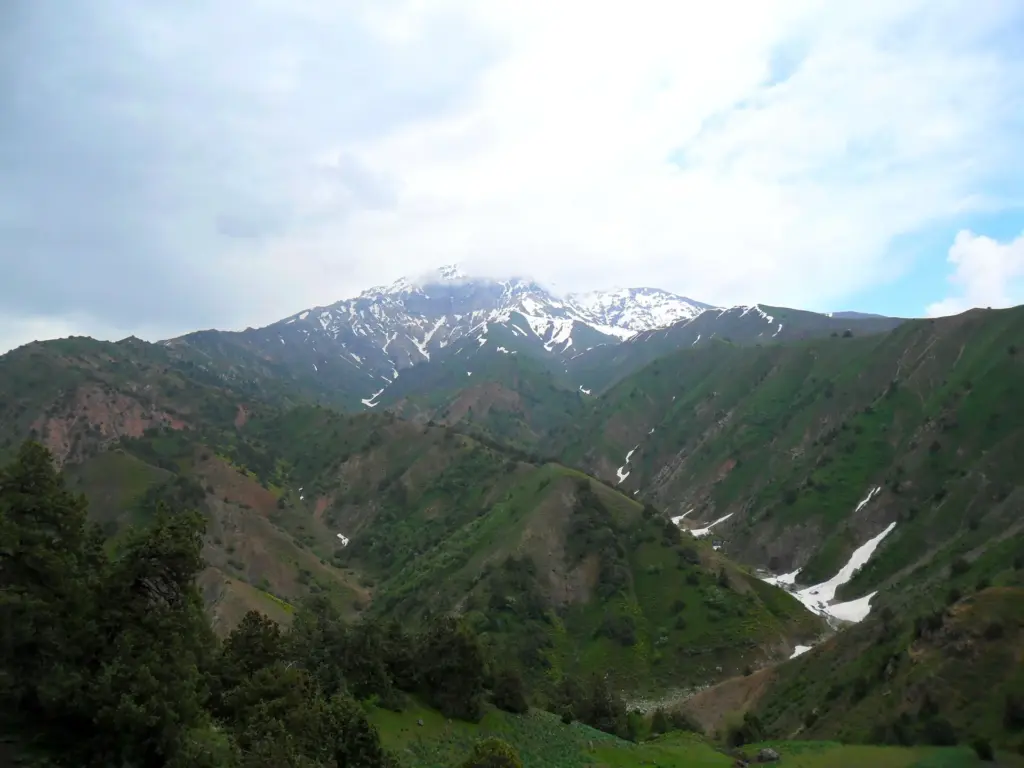
Where to go: the classic Tashkent — Samarkand — Bukhara — Khiva tour, day hikes from Tashkent, Zaamin.
Summer: June – August
In July Bukhara and Khiva reach +37…+40 °C in the shade, and that is not the limit. The cities come alive early in the morning and in the evening: Registan under floodlights, tea at Lyabi-Hauz after sunset — in summer that is the only sensible schedule. But summer is mountain season: Chimgan and the Ugam-Chatkal park are 10–15 degrees cooler, the high routes are open, and this is when people hike to the Urungach lakes and up Greater Chimgan. If you dream of the Fann Mountains or the Pamirs, that is July–September.
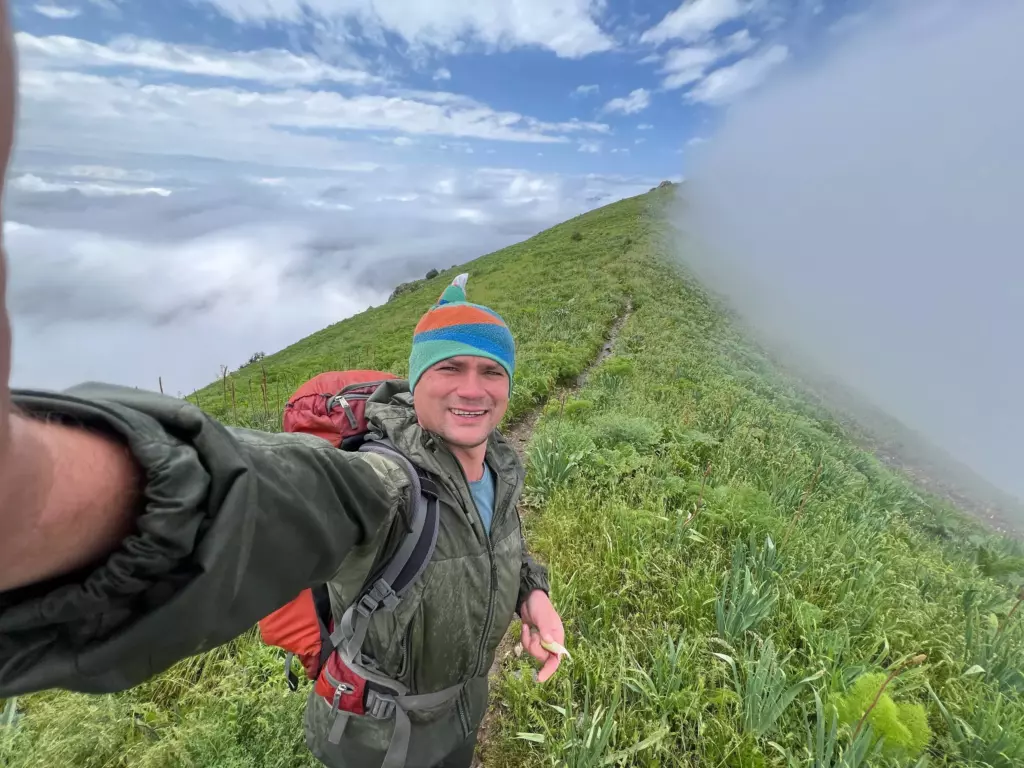
Where to go: trekking in the mountains of Uzbekistan, Chimgan Mountains in 3 days, Jade Lakes.
Autumn: September – November
The second golden window and the most popular season. September is still +30 °C, October +22 °C, there is no rain, and the bazaars are heaped with grapes, melons and pomegranates. It is comfortable everywhere: in the cities, in the desert and on mountain trails. The one downside is the crowds: Registan on an October Saturday feels like a railway station, and hotels in Bukhara are booked a month ahead. In November tourist numbers drop sharply; it is +14 °C by day and around zero at night — still a good time for the cities.

Where to go: a 7-day tour of Uzbekistan, a 10-day tour with the desert, Muynak and the Aral Sea.
Winter: December – February
Few tourists, lower hotel prices, and the ancient cities without crowds look special — a snow-covered Ichan-Kala or an empty Registan is worth the trip. Tashkent is +5…+9 °C by day with occasional snow; Khiva drops to −6 °C at night. Days are short: it gets dark around 5:30 p.m., so plan no more than two or three sights a day. From December the Amirsoy, Chimgan and Beldersay ski resorts are open, and winter hikes to the frozen Paltau waterfall or the upper Jade Lake are a genre of their own.

Where to go: Samarkand in one day, a sightseeing excursion to the mountains with the Amirsoy cable car.
Holidays and dates that affect your trip
| Date | What | Why it matters to a traveller |
|---|---|---|
| 1 January | New Year | public holidays 31 December – 3 January; Christmas trees and fairs in Tashkent |
| 8 March | Women’s Day | public holiday |
| 21 March | Navruz | public holiday; street festivities, sumalak, the most beautiful days of spring |
| 9 May | Day of Remembrance and Honour | public holiday |
| 1 September | Independence Day | public holiday; festivities, occasional road closures in Tashkent |
| October 1 | Teachers’ Day | public holiday |
| 8 December | Constitution Day | public holiday |
| approx. 8 February – 9 March 2027 | Ramadan (Ramazon) | restaurants are open, but some cafés close during the day; iftar at sunset; 9 March is Ramazon Hayit, a public holiday |
| approx. 16 May 2027 | Kurban Hayit (Eid al-Adha) | public holiday; the dates of both festivals follow the lunar calendar and are confirmed by decree |
Museums and sights stay open on holidays, but train tickets sell out a week ahead — especially around Navruz and the May holidays.
Documents and entry
Visa. Citizens of Russia, Kazakhstan, Belarus, Armenia, Azerbaijan, Georgia, Moldova and Ukraine need no visa and have no limit on the length of stay. Citizens of Kyrgyzstan can stay up to 60 days on an ID card. Visa-free entry for up to 30 days is open to citizens of more than 90 countries, including all EU states, the United Kingdom, the USA, Turkey, Israel, Japan, South Korea, China, the UAE, Indonesia and Malaysia. Everyone else applies for an e-visa at e-visa.gov.uz: 30 days, 20 US dollars, at least three days before travel.
Passport. An international passport is required, including for children of any age; a Russian internal passport is not accepted. It must be valid for at least three months after the end of your trip.
Registration. A foreign visitor must be registered at their place of stay within three days of arrival. Hotels, hostels and licensed guesthouses do this themselves through the E-mehmon system — you need not arrange anything, but keep the confirmations (paper or in the app) until you leave: border officers may ask for them. If you rent an apartment, the owner registers you via E-mehmon or the migration office. Russian citizens are covered by a 2022 agreement: the first 15 days from entry require no registration.
Tourist tax. Hotels charge it per night for every guest over 16. From 1 September 2026 the rates for foreigners are: hotels with more than 40 rooms — 66,000 som, 11–40 rooms — 44,000, up to 10 rooms — 22,000, guesthouses and private apartments — 8,800 som per night. That is 15, 10, 5 and 2 % of the base calculation unit (440,000 som), roughly 0.7 to 5.5 US dollars. Some hotels include the tax in the bill, others collect it separately at reception — ask at check-in so you don’t pay twice.
Customs. Cash above 100 million som (about 8,000 US dollars) must be declared on entry and exit; a 10,000-dollar declaration-free threshold is still only a plan, with the bill due by the end of 2027. Drones may not be brought in or flown without a permit — they are confiscated at the airport.
How to get there
International airports with flights from Russia: Tashkent, Samarkand, Bukhara, Urgench (for Khiva), Fergana, Termez and Namangan. A direct Moscow – Tashkent flight takes about four hours; there are also direct flights from St Petersburg, Kazan, Yekaterinburg, Novosibirsk and other cities, as well as from Almaty, Bishkek, Baku, Istanbul and Dubai. If your tour starts in Khiva or Bukhara, it is easier to fly straight there and finish in Tashkent — or the other way round — so you never backtrack.
Uzbekistan is UTC+5 (two hours ahead of Moscow) and does not change its clocks. From Tashkent airport to the centre is 20–30 minutes by app-hailed taxi.
Getting around the country
The Afrosiyob high-speed train is the main way to travel between cities: up to 210 km/h, air conditioning, a bistro car, and economy, business and VIP classes.
| Itinerary | Afrosiyob | Other trains |
|---|---|---|
| Tashkent — Samarkand | about 2 h 10 min, 3–4 departures a day | Sharq about 3 h 15 min; night trains |
| Samarkand — Bukhara | about 1 h 30 min | Sharq about 2 h 30 min |
| Tashkent – Bukhara | about 4 h 10 min | night train |
| Bukhara — Khiva | — | high-speed train about 3.5 h, several times a week (since May 2026); electric train about 4 h 40 min, six days a week (since September 2026); night train |
| Tashkent – Khiva | — | Jaloliddin Manguberdi high-speed train about 7.5 h, stopping in Samarkand and Bukhara (since May 2026); night train about 14 h |
Tickets are sold on railway.uz and in the Uzbekistan Railways app; you need the passport details of every passenger. In high season Afrosiyob seats sell out 1–2 weeks ahead, and boarding closes 30 minutes before departure. Timetables change by season — check railway.uz before buying. Bukhara – Khiva by road across the Kyzylkum takes 6–7 hours, but with stops at the desert fortresses of Khorezm it is more interesting than the train.
Taxis. The Yandex Go app works in Tashkent, Samarkand and Bukhara: the fare is shown in advance and you can link a card. If you hail a car on the street, agree the price before getting in.
The metro exists only in Tashkent: three lines, with the most beautiful stations being Kosmonavtlar, Alisher Navoi and Pakhtakor; pay with a bank card at the turnstile.
By car between cities is how we run our tours: a driver, stops in Gijduvan, at the Ayaz-Kala and Toprak-Kala fortresses, at Charvak. All our Uzbekistan tours include transfers — by train or car, depending on the route.
Money, cards and mobile data
The currency is the Uzbek som; bank exchange offices and the airport give almost the same rate, so there is no need to change money on the street. Visa and Mastercard cards issued by foreign banks are accepted in hotels, restaurants and chain shops, and ATMs dispense som from them. Important for visitors from Russia: cards of Russian banks, including Mir, do not work in Uzbekistan — bring cash in dollars, euros or roubles and exchange it locally. You will need cash in any case: at bazaars, in street taxis, at guesthouses in the mountains and for souvenirs from craftsmen.
A SIM card with internet is bought at an operator's store with your passport (Beeline, Ucell, Uzmobile), and an eSIM can be set up before you leave home. For details, see our cheat sheet "Money, Phone and Internet in Uzbekistan".
What to see and how many days you need
| Days | Itinerary | Our tour |
|---|---|---|
| 1–2 | Tashkent + Samarkand by Afrosiyob, or a day in the mountains | Classic Samarkand, hikes from Tashkent |
| 5 | Bukhara – Samarkand – Amirsoy mountains – Tashkent | 5-day tour |
| 7 | Bukhara — Gijduvan — Samarkand — Tashkent — Charvak | 7-day tour |
| 8 | Tashkent — Samarkand — Bukhara — Khiva | Classic Tour |
| 10 | Khiva – Bukhara – Samarkand – Tashkent + mountains and desert | 10-day tour |
- Samarkand — Registan (twice: by day and under floodlights), Gur-Emir, Shah-i-Zinda, Bibi-Khanym, the Siab Bazaar. At least a day and a half.
- Bukhara — Poi-Kalon, the Ark, the trading domes, Lyabi-Hauz in the evening, Chor-Minor. Two days, all on foot.
- Khiva — the whole of Ichan-Kala, sunset from the city wall or the Islam Khoja minaret. A day to a day and a half.
- Tashkent — Chorsu Bazaar, the Hazrati Imam complex with the Uthman Quran, the metro, a plov centre for lunch. One day.
- Mountains — Chimgan, Charvak, and the Ugam-Chatkal waterfalls, an hour and a half from the capital: ten weekend routes and a guide to Ugam-Chatkal Park.
- Beyond that — Muynak and the Aral Sea, the Nuratau Mountains with yurts, Termez, the Fergana Valley. That is already a second trip or a ten-day itinerary.
Step-by-step plans are in the articles "What to See in 5 Days", "in 7 Days" and "Samarkand, Bukhara, Khiva in a Week".
Food, etiquette and dress code
Plov isn't just for lunch, it's eaten at dinner too: in Tashkent's plov centers it's served from 11 a.m. to 10 p.m., and after that the cauldrons are empty. Tandoor samsa, lagman, shashlik, Samarkand flatbread, melons and peaches in summer, pomegranates in fall. The tea is green, poured to a third of the bowl: the less they pour, the more respect they show, it's not about saving tea.

Dress code. Uzbekistan is a secular country and city dress is relaxed, but mosques, mausoleums and madrasahs require covered shoulders and knees; in working mosques women need a headscarf, which is handed out at the entrance. A light scarf in your bag is handy. In villages and in the Fergana Valley people dress more modestly, and shorts on men look out of place there. In summer, light long-sleeved cotton protects from the sun better than bare skin.
Alcohol is sold freely in shops and restaurants, and the local wine and beer are perfectly decent. The minimum age is 21, and you will be asked for ID.
Ramadan barely affects a trip: restaurants for tourists stay open, but avoid eating and drinking ostentatiously in the street during the day, and in the evening cafés fill up for iftar — book a table.
Tipping is optional: restaurants often add a service charge; if not, 5–10 % is customary. Guides and drivers are thanked at the end of the trip.
Photographing people — ask first, especially women in villages. Military sites, border crossings and the airport may not be photographed; drones are banned.
Safety and health
Uzbekistan is one of the safest countries in the region for travellers, including women travelling alone: tourist police patrol Samarkand, Bukhara and Khiva, and city streets are fine to walk in the evening. The only risks are everyday ones: short change at the bazaar, taxi drivers without a meter, pickpockets in the Chorsu crowds.
- Phone numbers: 112 — the single emergency number, 1173 — the hotline of the Safe Tourism Department of the Interior Ministry, 1050 — mountain rescue (Ministry of Emergencies).
- Water — don’t drink from the tap; bottled water is sold everywhere. Wash fruit from the bazaar.
- Sun — from May to September wear a hat, use SPF 50 and drink two litres of water a day. Heatstroke in July is the most common tourist problem.
- Mountains — above 2,500 m altitude sickness is possible, so read our article "How to Prepare for High Altitude". In the mountains, rescuers can take hours to reach you — tell someone your route and don't go into canyons after rain.
- Pharmacies are in every neighbourhood, many open 24 hours; bring your own prescription medicines.
- Insurance is not required for entry, but for mountain routes it is worth having — with cover for active sports.
What to pack
- Always: comfortable shoes for cobbled streets (everywhere in Bukhara and Khiva), a scarf, sunscreen; no adapter needed — European sockets, 220 V.
- Spring and autumn: layers — +25 °C by day, +10 °C in the evening; a light jacket, and a windbreaker and fleece for the mountains.
- Summer: light, long-sleeved cotton and linen, a hat, a swimsuit (hotel pools, Charvak, waterfalls).
- Winter: a warm jacket, a hat, thermal underwear for Khiva and the mountains; houses in the old towns are poorly heated.
- For a hike — there is a separate list in the article "What to Take on a Hike in the Mountains of Uzbekistan".
Frequently asked questions
7 answers to frequently asked questions
What is the best month to visit Uzbekistan?
For the cities — April, May, September and October: +22…+30 °C by day, dry, everything in bloom or ripening. For the mountains — May to October; for multi-day trekking — June to September. If you have to pick one month for everything, choose the second half of April or the end of September.
Is October a good time to visit Uzbekistan?
Yes, it is the best autumn month: +22 °C by day in Samarkand, +23 °C in Bukhara, almost no rain, and bazaars full of fruit. The downside is peak season — book hotels and trains early.
Is January worth it?
If you don’t mind frost — yes: Tashkent is +7 °C by day, Khiva drops to −6 °C at night, but there are no crowds and prices are lower. Plan fewer sights per day, as it gets dark at half past five. In the mountains it is ski season.
Do Russian citizens need a visa?
No. Only an international passport valid for at least three months after the trip, including for children. There is no limit on the length of stay, and the first 15 days require no registration.
How many days do you need for Uzbekistan?
A minimum of 5 days for Samarkand, Bukhara and Tashkent; ideally 7–8 days including Khiva; 10 days with the mountains or the desert. See the day-by-day options in the table above.
Do Russian bank cards work?
No — neither Visa and Mastercard issued by Russian banks nor Mir. Bring cash in dollars, euros or roubles and exchange it at banks; cards from other countries work wherever there is a terminal.
Is it safe for a woman to travel alone?
Yes. Uzbekistan is a calm country, the tourist cities have tourist police, and locals are friendly and happy to help. The only thing to remember: dress more modestly in villages and working mosques, and carry a headscarf.
Didn’t find an answer?
Ask a questionThe easiest way to stop worrying about tickets, registration and train timetables is to choose an Uzbekistan tour for your dates: we will build a 5–10-day itinerary, advise on the best time for your holiday and meet you at the airport. And if you long for the mountains, one-day hikes and trekking from Tashkent run all year round.