Ugam-Chatkal National Park: history, top 5 waterfalls, peaks and places
The largest protected area in Uzbekistan begins an hour and a half from Tashkent. We break down what is actually worth seeing there, what it costs and what changed in 2026.
In this article
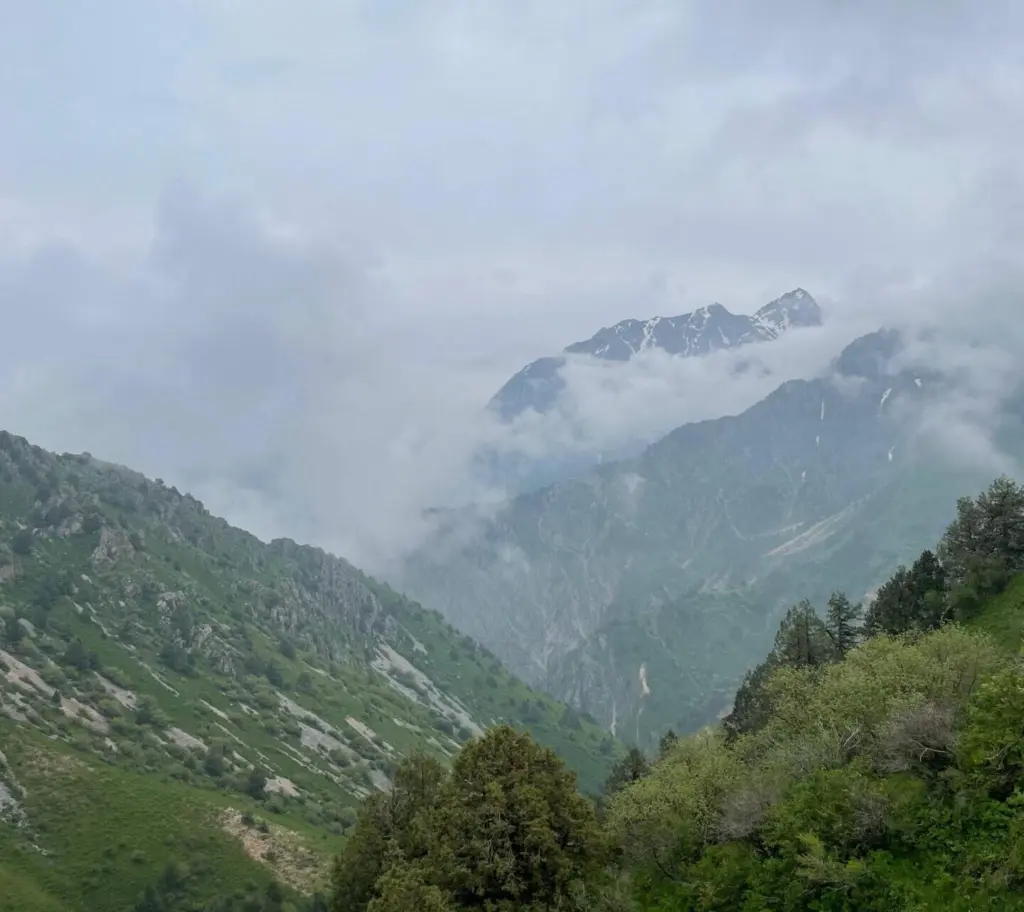
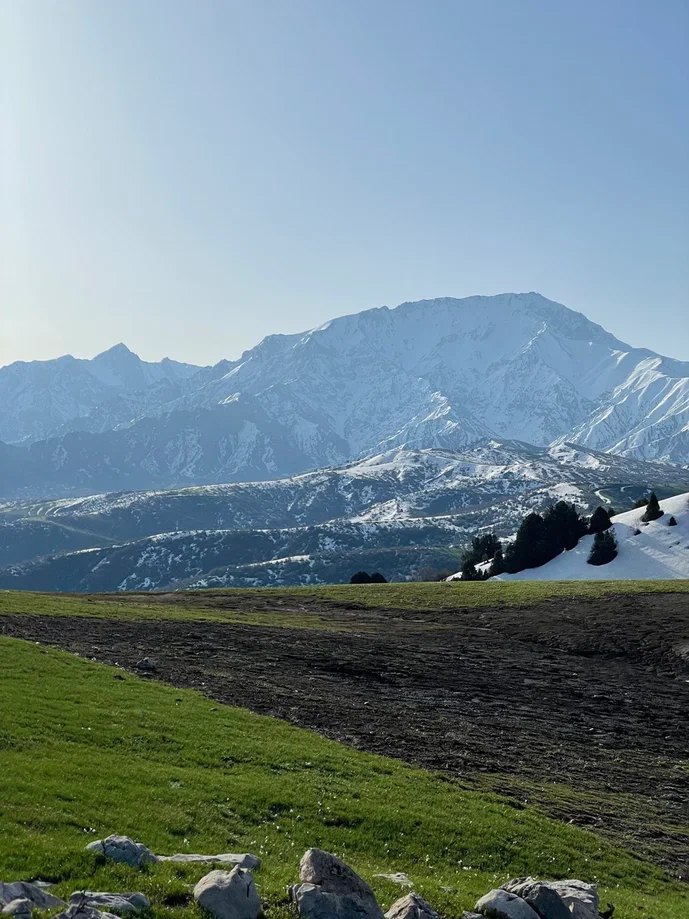
If you look northeast from Tashkent on a clear day, a wall of snow hangs over the city. These are the Chatkal and Pskem ranges of the Western Tian Shan, and almost everything you see is Ugam-Chatkal National Park. It begins 1.5–2 hours' drive from the capital, stretches to the borders with Kazakhstan and Kyrgyzstan, and holds ski resorts, a reservoir the size of a small sea, canyons the sun never looks into, and a plateau that takes two to three days to reach. We have been leading groups here for nine years now, and we will try to describe the park without the postcard gloss: what it is, what changed in 2026, and where to go first.
The park in numbers
| Established | 1990, Resolution No. 270 of the Council of Ministers of the Uzbek SSR of July 30 |
| Area | 574.6 thousand ha — according to the National Committee for Ecology (2025). Other sources give 668 thousand and 507 thousand ha: the park's borders and makeup have changed, and there is no single figure |
| Where | Tashkent Region: Bostanlyk, Parkent and Akhangaran districts; the administration is in Gazalkent |
| Elevations | from ~700 m in the Chirchik Valley to peaks above 3,500 m; Greater Chimgan — 3,309 m |
| Rivers | Pskem, Chatkal, Koksu (which feed Charvak), Ugam |
| Inside | Chatkal Biosphere Reserve (since 1947), the Beldersoy hunting grounds, the Chimgan, Beldersoy and Amirsoy resorts, the Charvak Reservoir |
| UNESCO | Two sections of the Chatkal Nature Reserve — Maydantal (24,706 ha) and Bashkyzylsay (11,018 ha) — have been part of the “Western Tian Shan” site since 2016 |
| Entry | 5% of the base calculation value per person per day: from September 1, 2026 that is 22,000 sum |
| To Tashkent | 65 km to Amirsoy, 80–95 km to Chimgan, about 100 km to Brichmulla |

A bit of history: from the 1947 nature reserve to the new park of 2026
These mountains were protected long before the park itself appeared. In 1947, the Chatkal Nature Reserve was established on the southern slopes of the Chatkal Range to protect its juniper forests and wild fruit trees: the ancestors of cultivated apple, walnut, and cherry plum trees grow here. In 1978, UNESCO added it to its network of biosphere reserves, and it remains the strictest zone of the park to this day: no tourists are taken there, only scientists.
The national park around the nature reserve was established in 1990, still in Soviet times, and combined the reserve with the Brichmulla and Akhangaran forestry enterprises. This is the source of the confusion over its area: in different years, forestry lands, resort zones and the reservoir were alternately included in the park and excluded from it. Since 2017, the park has been part of the forestry agency system, which in November 2025 became part of the new National Committee for Ecology and Climate Change.
In 2016 the Western Tian Shan — 13 sites in Kazakhstan, Kyrgyzstan and Uzbekistan — became a UNESCO World Heritage Site. An important caveat that guidebooks often skip: it was not the whole park that made the list, but two sections of the Chatkal Nature Reserve. So “UNESCO park” is a simplification, though the park's core really does hold the status.
The most recent change came in spring 2026. By a presidential resolution of March 25, a separate national nature park, Piskom, covering 156.7 thousand ha was created on the lands of the Brichmulla forestry enterprise, and the Ovjazsoy — Sinegorye park of 9.2 thousand ha was carved out of the Akhangaran forestry enterprise. In Piskom, permanent construction, vehicle entry and hunting are banned, hiking is allowed, and hotels and services are kept outside its borders. For the traveler this means the Pskem Valley is becoming the wildest and best-protected part of these mountains, and any figure for the area of Ugam-Chatkal you come across will soon be out of date once again.

What the nature is like here
The park is five altitude belts stacked on top of one another. Down low, along the Chirchik and Charvak, are orchards and riverside tugai woods. Higher up begins what it was all created for: the juniper (archa) forests, stands of tree junipers that can be several hundred years old. Higher still are the subalpine meadows, where Greig's and Kaufmann's tulips bloom in May, and then cliffs and snowfields.
In 2025 the National Committee for Ecology counted 1,787 plant species in the park, 66 of them in the Red Book, and 230 animal species, 46 of them Red-listed. Older reference books give bigger numbers, 2,200 and 280, but the order of magnitude is the same. Among the animals you will almost certainly not see, but which live here, are the snow leopard and Menzbier's marmot, an endemic of the Western Tian Shan. Among those you realistically can see: the more common marmots, chukar partridges, bearded vultures and black storks on the Pskem. There are bears too, the Tian Shan brown bear; over years of hiking we have come across its tracks far more often than the bear itself.
Top 5 waterfalls
The waterfalls of Chatkal are not Niagara, and not even the Carpathians. They are narrow mountain streams (sai) that thunder in April–May and turn into streams by August. That is why the main rule is to go to the water in spring and early summer.
| Waterfall | Where and what kind | How to get there | When |
|---|---|---|---|
| Paltau | Paltau Sai, a right tributary of the Chatkal, above the bridge at Obi-Rakhmat. Sources give its height anywhere from 82 to 131 ft (25 to 40 m): the stream drops from a ledge into a basin, and everyone measures it differently. Nearby is the Obi-Rakhmat grotto, where a prehistoric campsite was found | about 6 km to the waterfall along a trail by the stream from the road, with little elevation gain. Suitable for children | April — June, peak water in May |
| Gulkam Gorge | The Gulkamsay canyon on the slopes of Greater Chimgan: the walls close overhead, and along the bottom runs a cascade of three waterfalls, the largest about 10 m. The park's most photogenic route | From the village of Chimgan over Pesochny Pass (1,830 m) and down through the gorge, 4–6 h, about 6 km. Knee-deep fords, slippery slabs, ropes hang on two of the steps. Nobody goes into the canyon after rain | Mid-May — June, September — October |
| Nurekata | A waterfall on the Nurekatasay, in the gorge next to Aksagata beyond the Takhta Pass. We won't name its height: we found no measurements, and by eye it is about fifteen meters | Maygashkan — Nurekata — Aksagata loop: 25 km, 1,380 m of ascent, 10–11 hours. This is already a serious day | June — September |
| Ispay | A waterfall in the upper reaches of the Ispaysay on the Pskem Range, near the village of the same name. Since 2026 — part of the new Piskom park | Two days, 18 km, 700 m of ascent, with a night in the Surkhat tract. Moderate difficulty | June — September; check the access procedure for the Pskem Valley |
| Aksay Waterfalls | The Aksay gorge above Chimgan, on the way to Greater Chimgan; the Black Waterfall is around 40 m by the guides' estimate, there are no official measurements | 8 km from the Chimgan tract, on foot or on horseback, doable in a day | May — June |

Separately, there is Aksagata Canyon: a limestone gorge with river fords and scrambling over rocks beneath the Surenata ridge. The waterfall in its upper reaches is small, but the canyon itself is worth a day.
Top 5 peaks
| Summit | Altitude | How hard is it | What is up top |
|---|---|---|---|
| Greater Chimgan | 3,309 m | A long day: from Aksay (about 1,700 m) 7.5 km and 1,600 m of ascent, 6–7 h up, 5–6 h down. The popular route is along the western ridge, grade 1B; via Zhukovsky Pass it is a rock 2A with gear. First ascent — 1865 | The whole park laid out below you: Charvak, the Pskem Range and, on a clear day, Tashkent |
| Kyzylnura | 3,267 m | A separate route from Kumyshkan, usually with an overnight stay. The true summit (3,289 m) is two kilometers from the one everybody climbs | The Parkent side of the park, which hardly anyone sees |
| Okhotnichy Peak | 3,099 m | A very long day from Chimgan: 11 km one way, 7–8 h of climbing. In May there is still snow up top | The closest “three-thousander” to Chimgan, with a side-on view of Greater Chimgan |
| Kumbel | about 2,300 m | An easy walking summit above Beldersoy, once reached by the second section of the old cable car. The new resort opened in summer 2026 — check before your trip whether the lift runs for hikers | The weather station, the Beldersoy petroglyphs 8 km away at 2,450 m |
| Lesser Chimgan | 2,099 m | Half a day over Pesochny Pass, often combined with Gulkam. The best first summit of your life | All of Charvak and Greater Chimgan right across from you |
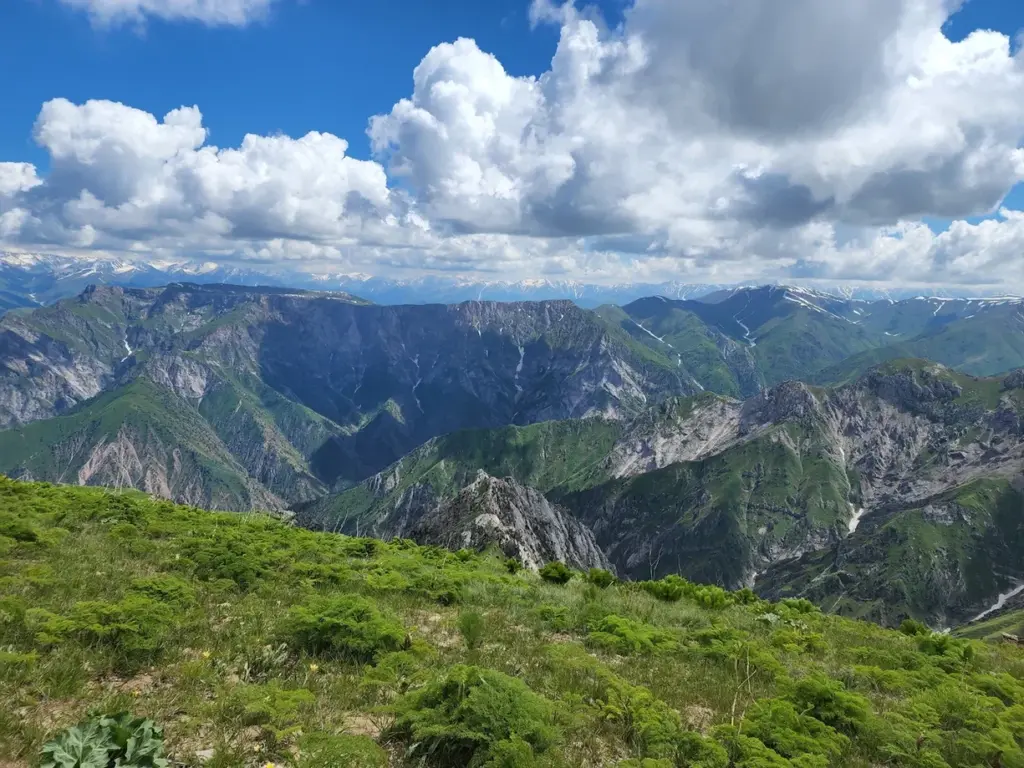
Not in the table are the Pulatkhan plateau (2,823 m), which is not a peak but a table mountain of about 8 km², reached by a single route along the ridge from Mount Karangur. It usually takes 2–3 days, from late June to September, when the snow melts. And Adelung Peak (4,301 m) in the Pskem Range, the highest point of the Tashkent Region: this is already mountaineering in a border zone and, from 2026, the territory of Pskom Park.
Top 5 places people come for
| Place | Why | How to get there | Prices 2026 |
|---|---|---|---|
| Charvak Reservoir | Turquoise water at 860 m in a ring of mountains. Area about 40 km², dam 168 m, filled in 1970. Swimming season runs from late May to September, water up to +25 °C | 90–100 km from Tashkent, the highway via Gazalkent; beaches at Yusufkhona, Bogustan, Sidjak, Brichmulla | Paid beaches from 150,000 sum for entry, tapchans (daybeds) extra; wild shores are free |
| Amirsoy | The park's most modern resort: two gondolas, top station at 2,290 m, in summer — trails, a climbing wall, a rope park, a pool. The cable cars run from 09:00 to 19:00 | 65 km from Tashkent, 1.5 h | Both gondolas round trip — 225,000 sum on weekdays and 255,000 on weekends, children 4+ — 115,000/130,000 |
| Chimgan | The historic heart of the mountains near Tashkent, and a big construction site: the MND resort with a tunnel, a TRYP by Wyndham hotel (opened in November 2025) and a cable car to Greater Chimgan; the old chairlift ran in summer 2026 for 40,000 sum. Next door, in Beldersoy, the Beldersoy Resort & Spa opened in summer 2026 | 80–95 km, 1.5–2 h | The new MND cable cars were promised for autumn 2026 — check before you go whether they are running |
| Khodjikent and Chinorkent | Plane trees several hundred years old, petroglyphs on a limestone cliff by the spring (ibex and argali, some of the images from the Eneolithic) and the Chinorkent gondola up to 1,661 m with a view of Charvak, running until 22:00 | 65–70 km, at the gateway to the mountains | Chinorkent round trip — 115,000 sum on weekdays, 135,000 on weekends, children aged 4–14 — 60,000/70,000 |
| Khumsan and the Ugam Valley | A quiet valley on the border with Kazakhstan, juniper forests, 9 km of rafting down the Ugam to the Khodjikent bridge in April — May | 80 km, the road runs north through Gazalkent | Rafting — from $150 per person with the operators |
Two more places, if you have time. The Pskem Valley up to Nanay is the end of the road and the start of the great Tian Shan; it is now the Piskom park, driving inside is prohibited, and part of the valley is a border zone. And Brichmulla at the confluence of the Chatkal and Koksu, the very Brichmulla from the Nikitins' song to Sukharev's lyrics, recorded in 1984.
Getting there and what a day in the park costs
There is almost no public transport to the mountains themselves: minibuses go as far as Gazalkent and Charvak, and from there you need a taxi or your own car. From Tashkent to Chimgan it takes one and a half to two hours, and on weekends from May to October the road near Gazalkent is jammed with traffic, so it is better to leave before eight in the morning.
| Expense | Amount |
|---|---|
| Park entrance fee | 22,000 sum per person per day (5% of the base calculation value) — that is what they charge at the entrance. The ticket is issued to the group leader with the route stated, at the entrance or online. For citizens of Uzbekistan: children under 7 free, schoolchildren and students half price |
| Taxi Tashkent — Chimgan | 300,000–450,000 sum per car one way, by arrangement |
| Amirsoy / Chinorkent cable cars | 225,000–255,000 / 115,000–135,000 sum |
| Lunch at a roadside chaikhana | 60,000–100,000 sum |
| A night at a guesthouse by Charvak | from 950,000 sum per room, peak season is July–August |
Rules, permits and safety
- The nature reserve is closed. Tourists are not allowed into the Chatkal Nature Reserve, and rightly so. All the routes in this article lie outside it.
- Tents and campfires are allowed only in designated places; leaving the roads and picking plants are prohibited. In Piskom, since 2026, there is also a ban on driving vehicles in.
- Border zone. The upper reaches of the Pskem and Ugam are border territory. For foreigners, entering the border strip requires permission from the border troops; a new regulation on the state border regime has been in effect since October 2024, and there is no up-to-date public list of "closed" villages. If your route goes above Nanay or Khumsan, clarify the procedure with your host in advance, not at the barrier.
- Drones are banned from import and use in Uzbekistan without a permit; since 2024, a first offense brings a fine and confiscation, but filming over the park is still not allowed.
- Rescuers: 1050 is the Ministry of Emergency Situations rescue service, 112 is the single emergency number. There is a fire and rescue unit in Chimgan: in October 2026, rescuers brought seven lost tourists down from Greater Chimgan. Above the resorts, phone coverage disappears, so tell someone your route in advance.
- Weather. At 1,600 m in July it is around +26 °C (79 °F) in the daytime, and at night it can be +10 °C (50 °F). Snow lies from December to April, and in May above 2,500 m it still lingers in the gullies. The most dangerous season in the canyons is the spring rains: mudflows come down within minutes.
When to go
| Months | What to do? |
|---|---|
| December — March | Skiing and snowboarding: Amirsoy, Chimgan and the new resort in Beldersoy |
| April — May | Tulips, waterfalls in full flow, rafting on the Ugam. Snow on the peaks |
| June | Gulkam, Paltau, Lesser Chimgan; start of the season at Pulatkhan |
| July — August | Greater Chimgan, Kyzylnura, Okhotnichy, Pskem; swimming and traffic jams at Charvak |
| September — October | The best time for everything at once: canyons, peaks, golden juniper forests, and the water still warm |
| November | Shoulder season: rain down below, first snow up top |

For more on the seasons in the mountains, see the article "Mountains near Tashkent: where to go for the weekend", and for packing, "What to bring on a hike in the mountains of Uzbekistan".
How to see the park with us
One-day trips from Tashkent: Paltau Waterfall and Lesser Chimgan for a first introduction, Aksagata Canyon for a walk with children, a sightseeing excursion to the mountains without a backpack: Charvak, Chimgan, the cable car. For two to three days: Chimgan Mountains in 3 Days with overnight stays and "In the Footsteps of the Tethys Ocean", a trek across limestone that was once the sea floor. If you want to see Chatkal, Nuratau, and Pskem in a single trip, there is the 12-day trekking tour in the mountains of Uzbekistan without backpacks. Before heading to the mountains, read about altitude sickness: on Greater Chimgan it happens more often than you might think.