


What to See in Uzbekistan in 5 Days: Bukhara, Samarkand, Tashkent and the Mountains
Five days means Bukhara, Samarkand, Tashkent and a day in the mountains. We explain how to fit it all in, what trains and tickets cost in 2026–2027, and where not to cut corners.
In this article
Five days in Uzbekistan isn't much, but it's enough to see the two main Silk Road cities and the capital without turning the trip into a marathon. We've been running this route for several years and have learned one thing: it's better to start in Bukhara and finish in Tashkent. That way the longest transfer falls in the middle of the trip, and on the last day you're in the city with the most flights home.
Below is a day-by-day plan, and at the end, the things people usually ask about once they're already at the airport: money, connectivity, registration and the tourist tax. Prices and rules were checked in October 2026 — you can plan a 2027 trip by them; if anything changes, we'll update.
How the Route Works
Bukhara → Samarkand → Tashkent → the mountains. Two nights in Bukhara, one in Samarkand, two in Tashkent. Between cities — the Afrosiyob high-speed train or a car; to the mountains — car only.
Why not start in Tashkent? You can, and many do. But then you'd arrive in Bukhara tired, mid-trip, and it's a city that demands an unhurried pace. If you fly into Tashkent, simply flip the route: Tashkent — Samarkand — Bukhara, and fly out of Bukhara. Direct flights to Bukhara from Moscow are operated by Utair, Uzbekistan Airways, Aeroflot and Qanot Sharq; in summer 2026 there were also flights from St. Petersburg, Yekaterinburg and Novosibirsk. The flight takes 3 hours 50 minutes.
Day 1. Bukhara: The Old City on Foot
You arrive in the morning, check in, and don't go anywhere until evening. Bukhara's historic center is compact, everything essential fits into one long day, and you won't need a car here.
Start with Lyab-i Hauz — a pond lined with mulberry trees, surrounded by madrasas and a 16th–17th-century khanqah. Here too stands the monument to Khoja Nasreddin on his donkey, the only place in town where tourists line up for photos. From Lyab-i Hauz, through the trading domes — Toki-Sarrafon, Toki-Telpak-Furushon, Toki-Zargaron — you'll reach Po-i-Kalyan: a minaret from 1127 that even Genghis Khan spared, a mosque for ten thousand worshippers and the working Mir-i-Arab Madrasa opposite. Entry to the square is free; the mosque courtyard is 20–30,000 sums. The minaret is currently closed to climbing.
Next — the Ark Fortress, the residence of the emirs of Bukhara (tickets for foreigners around 60,000 sums), and behind it, in the park, the Samanid Mausoleum from the 10th century. It's the oldest building on the route, and it impresses not with its size but with its brickwork: the pattern changes depending on the angle of the sun. Come closer to evening.
Dinner — plov at a chaikhana by Lyab-i Hauz or in one of the old city's courtyards. Bukhara plov is made differently from Tashkent's: the rice, meat and carrots are cooked separately and only come together on the plate.
Day 2. Bukhara: Country Palaces and Crafts
In the morning — Sitorai Mokhi-Khosa, the summer residence of the last emir, 4 km from the city: a mix of oriental palace and early-20th-century Russian manor, with peacocks in the garden. Then Chor-Bakr, a 16th-century necropolis with quiet courtyards that tour groups rarely reach. After lunch, return to the center and visit the workshops: Bukhara metal chasing, gold embroidery, miniature painting — all made right here in the cells of former madrasas, and you can watch the masters at work without buying anything.
If you still have energy — the Bozori-Kord hammam, in business since the 16th century. Men's and women's days alternate; check on site.
Day 3. Transfer to Samarkand and the Registan
Train or car? The Afrosiyob from Bukhara to Samarkand takes about an hour and a half; an economy ticket is around 165,000 sums. By car it's 270 km and 3–3.5 hours, but you can stop in Gijduvan at the Narzullaev family's pottery workshop, whose ceramics with birds and pomegranates sit in museums.
A note on tickets. Train sales open 60 days ahead, and for popular dates in April–May and September–October seats sell out within the first hours. Buy on railway.uz or in the Uzbekistan Railways app, but Russian cards don't work there — you'll need a foreign bank card or help from your host. It's one reason the transfers in our tours are arranged in advance.
If you go by train, look out for the new “Jaloliddin Manguberdi” train launched in May 2026: it runs from Tashkent via Samarkand and Bukhara to Khiva, reaches 250 km/h and departs every other day.
In Samarkand, check in during the day and by four o'clock head to the Registan. Tickets for foreigners — 100,000 sums, under 18 — 50,000; in season (until November 20) the square is open from 7 a.m. to midnight. The three madrasas — Ulugbek, Sher-Dor and Tilla-Kari — are best seen at sunset, when the majolica on the facades shifts from turquoise to gold, and then stay until the lights come on. Inside Tilla-Kari, don't miss the mihrab with the gilded dome: it's flat, but painted so that it looks three-dimensional.
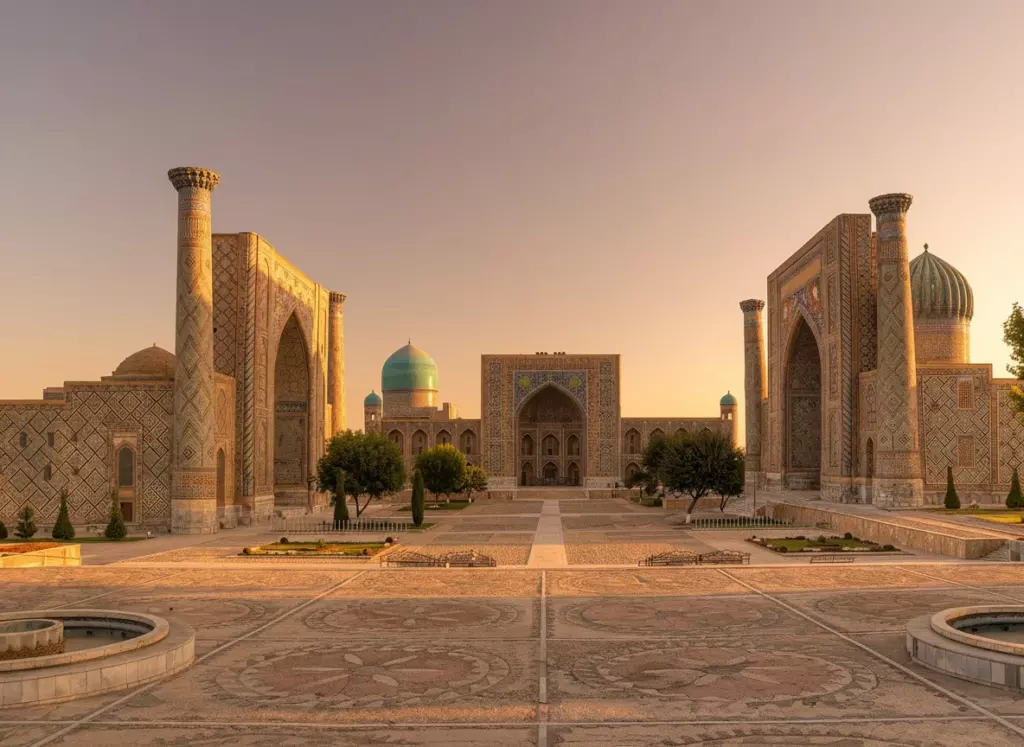
In the evening — dinner overlooking the square: there are several rooftop restaurants around the Registan.
Day 4. Samarkand in the Morning, Tashkent in the Evening
Half a day in Samarkand means Shah-i-Zinda (tickets around 80,000 sums), a street of 14th–15th-century mausoleums where each portal outdoes the last in tilework; Gur-e Amir, Tamerlane's tomb with its jade headstone (around 75,000); and Bibi-Khanym, the largest mosque of its time, which Timur built after his campaign in India. Next to Bibi-Khanym is Siab Bazaar: come here for Samarkand non bread — locals insist the real thing is baked only here and stays fresh for a week.
There's no single ticket for Samarkand's monuments; each site has its own ticket office. Bring cash: card terminals aren't everywhere.
After lunch — the Afrosiyob to Tashkent. Two hours on the way; since February 1, 2026 a ticket costs 311,000 sums in economy, 455,000 in business and 709,000 in VIP: roughly $26, $38 and $60. Trains run several times a day, and you'll be in Tashkent by dinner.
Day 5. Tashkent or the Mountains
Here the route splits, and the choice depends on your flight.
If you fly out late in the evening or the next morning — head for the mountains. Chimgan and Amirsoy are about an hour and a half from Tashkent by car. In October the cable cars are still running on the slopes (Amirsoy has two gondolas, from 9 to 19; check the fall schedule and prices at amirsoy.com — the official rates aren't published on the site), the upper stations open up views of the Chatkal ridges, and on the way back it's worth stopping at the viewpoint above the Charvak Reservoir. Its water stays turquoise until November, but it's already too cold to swim. Have shashlik for lunch at one of the roadside cafés on the way to Charvak and return to the city by evening.
If you fly out in the afternoon — give the day to Tashkent. In the morning — the complex of Hazrati Imam with the Uthman Quran — by tradition, the very one the third caliph was reading when he was killed; scholars date the manuscript to the 8th–9th centuries, and it's still one of the oldest Qurans in the world (the grounds are free, the museum is paid), and the Chorsu bazaar under a turquoise dome: come here for dried apricots, almonds and suzani. Take a ride on the metro — the Kosmonavtlar, Alisher Navoi and Pakhtakor stations were built as underground palaces, and photography was only allowed here in 2018. From October 1, 2026 a ride costs 2,500 sums by card or phone, 3,000 in cash. In March 2026 the Center of Islamic Civilization opened by Hazrati Imam — a huge museum complex worth setting aside two or three hours for, if time allows.

What to Know Before You Go
Documents. Russian citizens don't need a visa; entry is with a passport, including for children. Hotel registration is handled automatically; for stays of up to 15 days no separate registration is needed, and if you rent an apartment for longer, the owner registers you through the emehmon.uz portal. Check before departure that your passport is valid.
Tourist tax. Only foreigners pay, per night, usually at check-in. Currently in hotels with more than 40 rooms it's 61,800 sums (around $5), less in small hotels and guesthouses. For five nights, budget up to $25 per person.
Money. The Central Bank rate on October 11, 2026 is 11,898 sums to the dollar and 140 sums to the ruble. Russian Mir cards and Visa and Mastercard from Russian banks don't work — that's been the case since 2022, and nothing has changed for the 2026–2027 season. Bring cash dollars and exchange them at banks or official exchange offices — there are plenty, and the rate is close to the official one everywhere. At markets, in taxis and in small cafés people pay cash; restaurants and hotels have card terminals.
Connectivity. A tourist SIM card is sold with a passport at operators' stores, including at Tashkent airport; a 15–30 GB package costs within $2–5. There's no need to register your phone's IMEI for a five-day trip: the local network works for 30 days without registration.
Weather. October is the best month for this route: +22 by day in Samarkand and Bukhara, +7…+8 at night, cooler in the mountains. In November it's +14 by day in the cities and around +3 at night, and the Registan switches to winter hours from November 20. In spring the same route works well in April and May. More on the seasons in the article “When Is the Best Time to Visit Uzbekistan”.
Clothing. In mosques and mausoleums — covered shoulders and knees, and that goes for men too. Shoes — comfortable: in Bukhara and Samarkand you'll walk 12–15 kilometers a day.
Budget for an Independent Trip
Going independently: a guesthouse in the old city of Bukhara or Samarkand — $30–60 per night, a boutique hotel or 3-star — $60–100. Trains on the route — about $40 per person, entry tickets — another $30–35, tourist tax — up to $25. Food at chaikhanas is cheap: plov with salad and tea — $4–6.
If you travel with us, a 5-day tour of Uzbekistan along this same route costs $550 per person: hotels, transport along the entire route with a driver, guided tours in three cities and a day in the mountains. Flights to Uzbekistan are not included. We book the transfers and tickets ourselves, so card problems and sold-out Afrosiyob trains won't affect you.
Want it longer? A week-long route with Gijduvan and Charvak — a 7-day tour of Uzbekistan, and if you want Khiva too — the classic 8-day tour.


