

What to see in Tashkent in 1, 2 or 3 days: itineraries through the old town, the centre and the surroundings
Tashkent is nothing like Samarkand: there is no single Registan here, but there is an old town, Soviet modernism, the most beautiful metro in Asia and mountains an hour and a half away. We have put together itineraries for one, two and three days — and for a few hours between flights.
In this article
Tashkent is rarely the destination itself — more often it is the first or last city before Samarkand, Bukhara and Khiva, and people give it a day, or even just a few hours between flights. That is unfair: here you have an old town with 16th-century madrasahs and a 7th-century Quran, the best Soviet modernism in Central Asia, a metro that people photograph instead of museums, and mountains an hour and a half away. We run walking tours of Tashkent and have put together itineraries for any amount of time, from three hours to three days. All distances are on foot or by metro, no car needed.
If you only have a few hours
The airport is 5–8 km from the centre: 20 minutes by app-hailed taxi, so even a 5–6-hour layover gives you two or three sights. Go for the old town — it is compact and the most “Tashkent” part of the city: the Hazrati Imam complex with the new Centre of Islamic Civilization, then a 15-minute walk to Chorsu Bazaar and the Kukeldash madrasah, and back by metro with a change at Kosmonavtlar to see the most famous station. If your flight is in the daytime, you will make it in time for plov: the freshest is served around noon.
Day 1: the old town and the centre
The classic route that fits into one daylight day and that opens our walking tour of Tashkent.

| Time | What | Why |
|---|---|---|
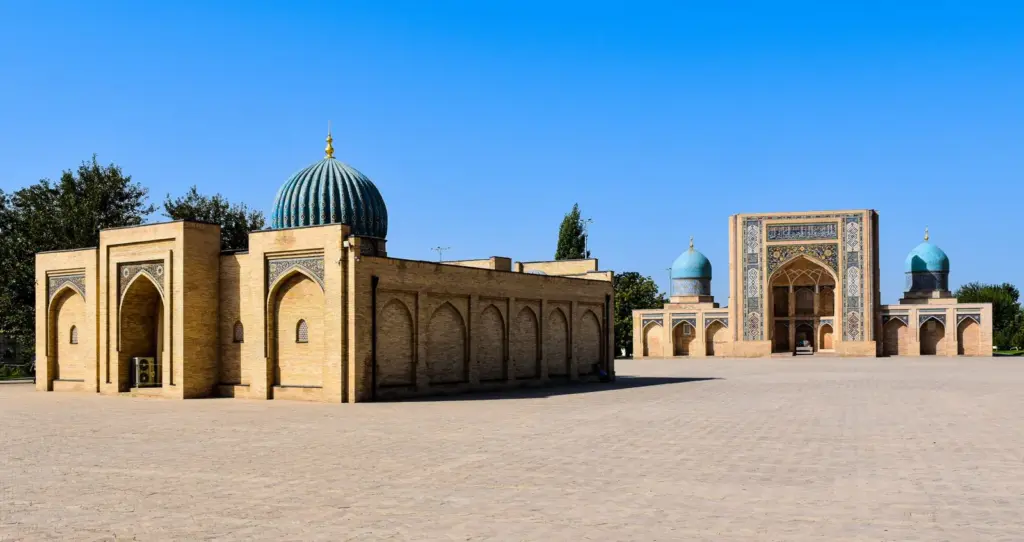
| 9:00 | Hazrati Imam | the city’s spiritual centre: the Kaffal Shashi mausoleum (1542), the Barak-Khan (1532) and Muyi Muborak (1857) madrasahs, the Tillya Sheikh mosque and the 2007 congregational mosque |
| 10:00 | Center of Islamic Civilization | opened on 17 March 2026 next to the complex: a museum of 8,350 m², 114 rare Quran manuscripts and the Uthman Quran — a 7th-century manuscript on parchment, kept in Muyi Muborak since 1989 |
| 12:00 | Chorsu and Kukeldash | the bazaar under the turquoise 1980s dome — spices, dried fruit, bread, kazy sausage; next to it the 16th-century Kukeldash madrasah and the Khoja Akhrar Vali Friday mosque |
| 13:00 | lunch | tandoor samsa by Chorsu or plov in an old-town teahouse |
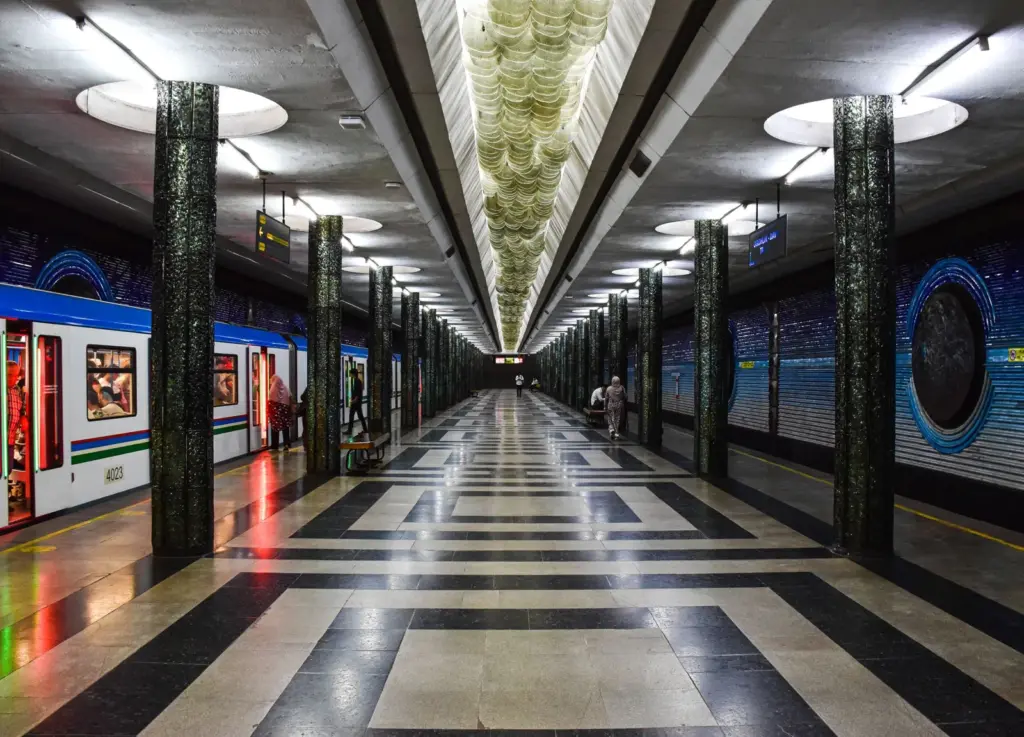
| 14:30 | the metro | from Chorsu to Kosmonavtlar: a 1984 station with cosmonaut portraits on blue — photography allowed since 2018 |
| 15:00 | Amir Temur Square | the Tamerlane monument, the chiming clock, the Hotel Uzbekistan — the symbol of Soviet Tashkent; the Timurid museum is next door |
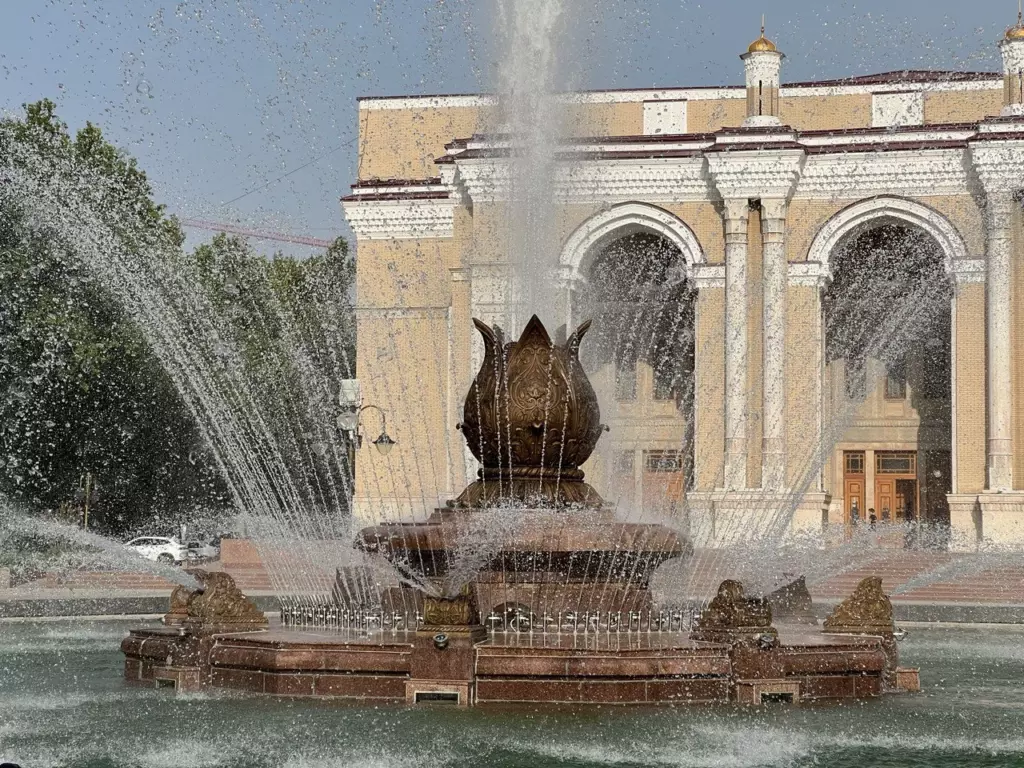
| 16:00 | Broadway and the Navoi Theatre | Sayilgokh street with artists and a flea market; the 1947 theatre designed by Shchusev, with six foyers in the styles of six regions |
| 17:00 | Romanov Palace | the late-19th-century mansion of Grand Duke Nikolai Konstantinovich on the way to Independence Square — viewed from outside |
| 17:45 | Independence Square and the Courage monument | the Ezgulik arch and fountains; the 1976 monument to the earthquake of 26 April 1966, with the clock on the stone stopped at 5:24 |
| 19:00 | Tashkent City | a park with illuminated fountains — evening Tashkent; for dinner, the restaurants around the park |
With a guide the day takes 6–8 hours including lunch; on your own, allow the whole day and plan nothing for the evening except the park.
Day 2: museums, Minor Mosque, the TV tower and plov
The second day is about 20th-century Tashkent and about things that no other city in the country has.
- The Museum of Applied Arts in the early-20th-century mansion of the diplomat Polovtsov: carved ganch, suzani embroidery, ceramics from Rishtan and Gijduvan — the best place to learn what to buy at the bazaar. Nearby is the State Museum of the History of Uzbekistan, if you want the context from the Silk Road to independence.
- Minor Mosque (2014) — white marble and a blue dome on the bank of the Ankhor canal, room for 2,400 worshippers; entry is free, women need a headscarf.
- The TV tower — 375 m, with an observation deck at 94 m overlooking the whole city and, on a clear day, the mountains, and the revolving Koinot restaurant at 98–104 m. At its foot is the Central Asian Plov Centre (Besh Qozon): plov is cooked here in cauldrons holding hundreds of portions; the centre is open from 11 a.m. to 11 p.m., but people come around noon for the freshest plov — it is a lunch dish.
- The Memorial to the Victims of Repression on the bank of the Ankhor next to the TV tower — a quiet park with a museum, 20 minutes.
- Alay Bazaar — the “city” bazaar in the centre, smaller than Chorsu and more convenient for shopping to take home: nuts, dried fruit, spices.
- Evening — Magic City (2021): an amusement park with restaurants styled as an illuminated “European town”; or a performance at the Navoi Theatre — opera and ballet tickets are inexpensive, the hall seats 1,440, and the programme is on the theatre’s website.
Day 3: the mountains, the Institute of the Sun or Samarkand
The third day in Tashkent is spent outside the city — the choice depends on what you haven’t seen yet.

- The mountains. Chimgan, the Charvak reservoir and the Amirsoy cable car are 80 km and an hour and a half to two hours from the city: a sightseeing trip to the mountains with the plane trees of Chinorkent and a ride up to 2,290 m, or a one-day hike to the Tavaksay or Paltau waterfalls or up Small Chimgan. Which one to choose is in the article “Mountains near Tashkent: the top 10 routes”.
- The Institute of the Sun in Parkent — the Big Solar Furnace, 50 km from the city, a half-day excursion that can be combined with the Sukok winery. The story of the site is in our article.
- Samarkand in a day. The Afrosiyob train takes 2 hours 10 minutes: leave at 7:30, see Registan, Gur-Emir, Shah-i-Zinda and the Siab Bazaar, and return on the evening train. That is how our one-day “Classic Samarkand” tour works. In season, buy train tickets a week ahead.
Tashkent in the evening
The city comes alive in the evening: in summer because of the heat, in winter because it gets dark at half past five. Where to go:
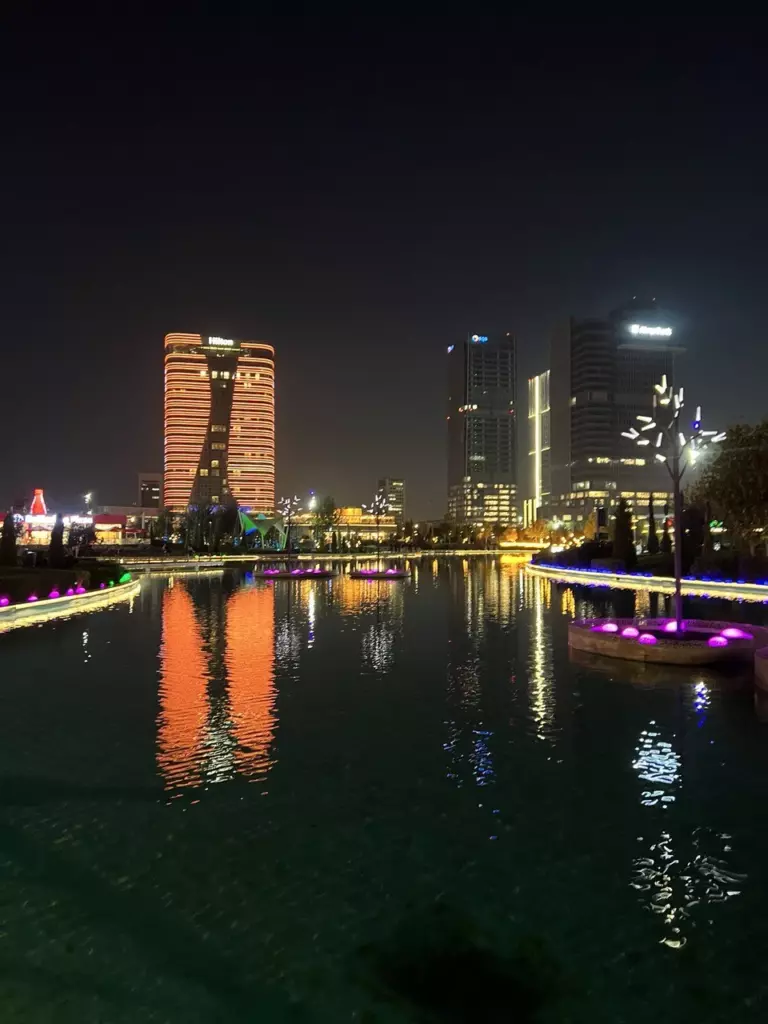
- Tashkent City — illuminated fountains, cafés, views of the towers of the new centre; the most photographed place after sunset.
- Broadway and Amir Timur Square — artists, street musicians, the chiming clock and the floodlit Hotel Uzbekistan.
- Magic City — if you are with children or in the mood for rides.
- The TV tower — dinner with a view of the night city in the revolving restaurant.
- The Navoi Theatre — opera and ballet in a building constructed by Japanese prisoners of war; performances start at 6–7 p.m.
- The plov centre by the TV tower is open until 11 p.m., but evening plov is not the same — for dinner, choose the Uzbek restaurants in the centre.
Tashkent in winter and summer
In winter it is +5…+9 °C by day with occasional snow: the day-1 route can be done in full, the evening goes to Tashkent City and the theatre, and the third day to skiing at Amirsoy or Chimgan. In July it is +36…+40 °C: the old town and the bazaar before 11 a.m., museums and the metro in the heat of the day, parks after 7 p.m.; in summer the third day is for the mountains only, where it is 10–15 degrees cooler. The best months for the city are April–May and September–October — more in the guide “When to visit Uzbekistan”.

Practical details
- Metro — three lines plus a ring line, 50 stations; pay with a bank card, foreign ones included, at the turnstile or with a QR ticket from the kiosk. The most beautiful stations: Kosmonavtlar, Alisher Navoi, Pakhtakor and Mustakillik Maydoni.
- Taxis — Yandex Go; take cash in som for the bazaar and the old town, cards don’t work there. How to pay and where to exchange is in our money and connectivity cheat sheet.
- Mosques and Hazrati Imam — covered shoulders and knees, a headscarf for women; the Centre of Islamic Civilization has museum rules and audio guides in several languages, and in high season it is best to book tickets in advance.
- Photography — allowed in the metro, not at the airport or near military sites.
- Water and sun — in summer carry a bottle of water and a hat from the morning on; the old town has almost no shade.
Frequently asked questions
7 answers to frequently asked questions
What are the must-see places in Tashkent?
If just one place — the Hazrati Imam complex with the Centre of Islamic Civilization and the Uthman Quran. If three — add Chorsu Bazaar with the Kukeldash madrasah and Kosmonavtlar metro station. That is the old town and Soviet Tashkent in half a day.
How many days do you need for Tashkent?
One day for the old town and the centre, two to add the museums, Minor Mosque and the TV tower, three with a day trip to the mountains, the Institute of the Sun or Samarkand on the Afrosiyob train. More than three days in the city itself is usually unnecessary.
What can you see in Tashkent in a few hours?
Hazrati Imam and Chorsu — they are close together in the old town, 20 minutes from the airport by taxi. Return by metro via Kosmonavtlar. If your layover is in the daytime, you will make it for plov at a teahouse by the bazaar — it is served from 11 a.m.
Where to go for a walk in Tashkent in the evening?
Tashkent City with its fountains, Broadway and Amir Timur Square, Magic City, dinner at the TV tower or a performance at the Navoi Theatre.
Is photography allowed in the Tashkent metro?
Yes, since 1 June 2018. No tripod or flash; Kosmonavtlar and Alisher Navoi are the most photogenic stations.
What is there to see in Tashkent in winter?
Everything you would see in summer: the old town, museums, the metro, Tashkent City in the evening. For the third day — Amirsoy or Chimgan: the ski season runs from December to March. It gets dark at half past five, so plan no more than four sights a day.
Where can you go from Tashkent for a day?
To the mountains — Chimgan, Charvak, Amirsoy or a hike to the waterfalls; to the Institute of the Sun in Parkent; to Samarkand on the high-speed train. We offer all three as one-day tours.
Didn’t find an answer?
Ask a questionWant to see Tashkent through local eyes rather than on a map? Our walking tour of the centre takes 6–8 hours and covers the whole day-1 route, from the Museum of Applied Arts to Tashkent City. For the second and third days — a trip to the mountains, the Institute of the Sun or Samarkand in a day.


